Blog
A Trellis Might Be the Most Transformative Thing You Add to Your Garden This Year

(Plus 15+ Worth a Look at Wayfair)
This post is brought to you in partnership with Wayfair. All opinions, plant suggestions, and design hot takes are entirely our own.
There’s a particular kind of magic that happens at the edge of a yard — where the manicured part gives way to the wild part, where the lawn ends and the woods begin. In our yard, that edge needed something to mark it. Not a fence (too final). Not a gate (too formal). What that spot was asking for, it turned out, was a trellis.
We positioned a tall, arched wooden trellis that we got at Wayfair at the top of a small set of brick steps, framing the path that leads into the wooded back portion of the yard. The result is the kind of detail that feels small in theory and huge in practice — suddenly there’s a sense of… arrival. A place where the eye wants to land, where you instinctively slow down on your way out to the trees.
That’s what a trellis can do. And honestly? It’s one of the most underrated pieces of garden architecture out there.

The Case for a Trellis
A trellis is one of those rare outdoor pieces that does double duty: It’s both a structural element and a living one. Bare, it gives a yard shape and rhythm. Covered in greenery and bloom, it turns a flat garden into something with layers, height, and movement. It’s also surprisingly low-lift. Unlike a pergola or an arbor with footings, most trellises can be installed in an afternoon with little more than a few stakes and some patience. And because they pull the eye upward, they’re one of the easiest ways to make a small garden feel bigger.

Where to Put One
The instinct with a trellis is to push it against the back of a flowerbed and call it done. But there’s room to be more interesting than that. A few ideas worth stealing:
- As an entryway. Mark the transition from one part of the yard to another — like where the lawn meets a wooded path, or where a side yard turns toward the back. An arched trellis becomes a literal portal.
- Flanking a gate or doorway. A matched pair on either side of a garden gate (or even on either side of a back door) instantly elevates the entrance.
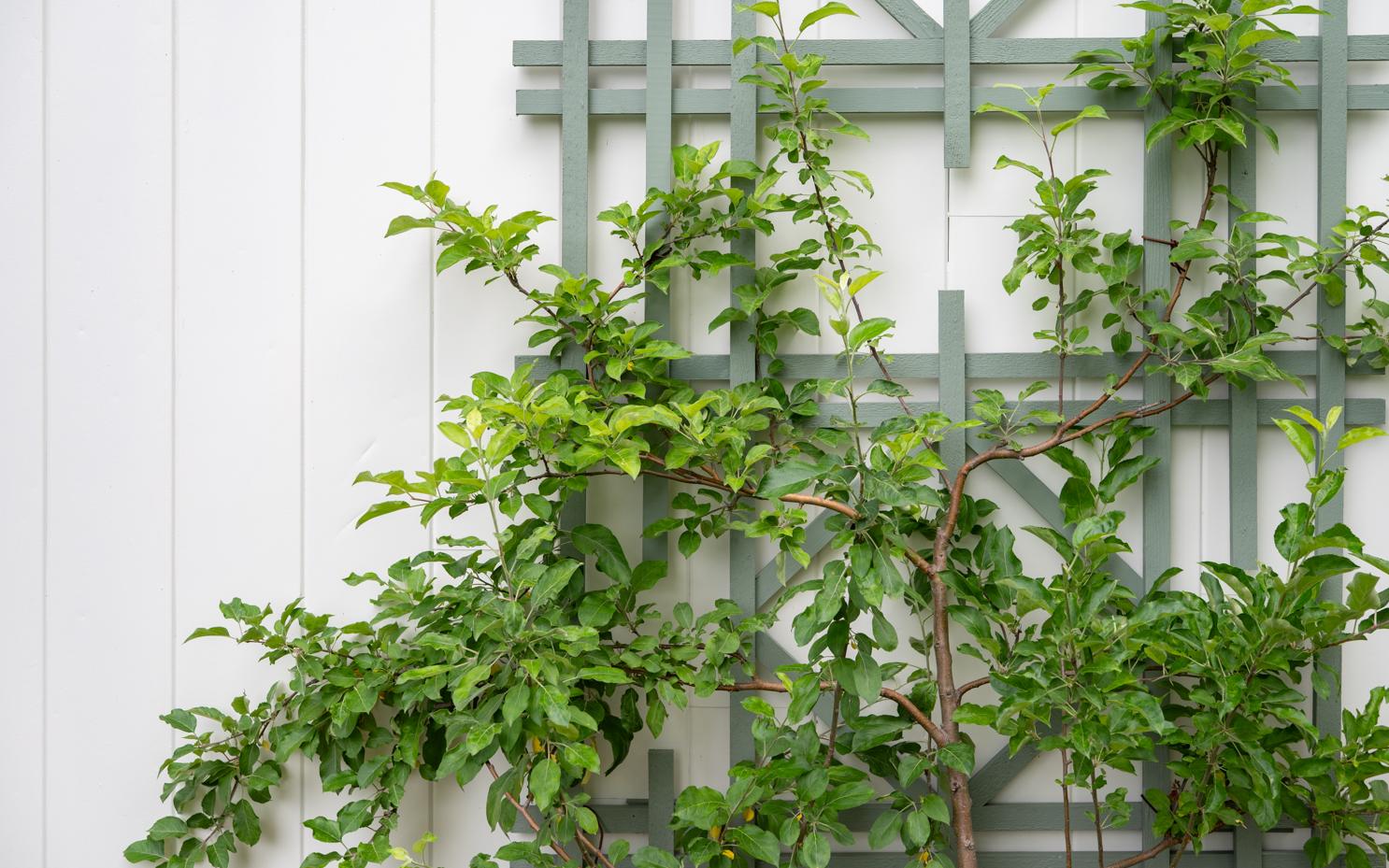
- Against a blank wall or fence. A flat-panel trellis covered in jasmine or climbing roses turns a forgettable expanse into a living tapestry. Renters: this is the trick.
- As a privacy screen. A tall, freestanding trellis can shield a patio dining area from the neighbors’ sightlines without the visual heaviness of a fence. Especially great for small yards and balconies.
- As the spine of a vegetable garden. Pole beans, cucumbers, peas, and even small melons love to climb. A simple obelisk in the middle of a raised bed turns “vegetable garden” into “potager.”
- Behind a bench or seating moment. Use a trellis the way you’d use a headboard. It’s the backdrop that frames the seat and gives it weight.
- Anchoring a corner. Two trellis panels meeting at a corner of the yard create instant structure and the perfect spot to layer in tall perennials at the base.

What to Grow on It: A North Carolina Edition
Most of North Carolina sits in growing zones 7b through 8a, which means gardeners here have a delightfully wide menu of climbers to choose from — evergreen, deciduous, native, fragrant, fast, slow, dramatic. A few favorites to consider:
Tried-and-True Perennial Climbers
- Carolina jessamine (Gelsemium sempervirens) — Glossy evergreen foliage and bright yellow trumpet-shaped blooms in early spring. Practically foolproof, and looks gorgeous draped over an arch.
- Confederate jasmine (Trachelospermum jasminoides) — Often called star jasmine. The fragrance alone is worth growing it; in early summer, the entire yard will perfume from one well-placed vine. Evergreen in most of NC.
- Clematis — A classic for a reason. Plant a few different varieties for staggered bloom times: ‘Jackmanii’ for deep purple, ‘Henryi’ for clean white, ‘Sweet Autumn’ for a late-season cloud of fragrant white flowers.
- Climbing roses — ‘New Dawn,’ ‘Zephirine Drouhin,’ and ‘Don Juan’ are NC-friendly workhorses. Train them onto an iron or steel trellis for that cottage-garden look that never goes out of style.
- Coral honeysuckle (Lonicera sempervirens) — A native, well-behaved alternative to the invasive Japanese honeysuckle. Tubular red-orange flowers that hummingbirds adore.
- Crossvine (Bignonia capreolata) — Underused and underrated. NC native, semi-evergreen, with apricot-and-yellow blooms in spring. Wonderful on tall trellises.
- American wisteria (Wisteria frutescens) — Skip the Asian varieties (they’ll eat your house and your neighbor’s). The American native blooms beautifully and stays in its lane.
- Climbing hydrangea (Hydrangea petiolaris) — Slow to establish, but worth the wait. Lacy white blooms and an architectural growth habit. Best in part shade — a great pick for a trellis on the north side of the house.
Annual Climbers (For Instant Gratification)
- Black-eyed Susan vine, morning glories, hyacinth bean vine, and mandevilla all bloom their hearts out from late spring through frost and won’t ask much in return. Plant a few seeds in May; have a flowering trellis by July.
Edible Climbers (For the Kitchen Garden)
- Pole beans — ‘Trionfo Violetto’ is a stunner with purple pods.
- Sugar snap peas — Cool-season; plant in early spring and again in fall.
- Small-fruited cucumbers and melons — ‘Sugar Baby’ watermelons and pickling cucumbers both happily climb.
A quick note: the heavier the climber (wisteria, climbing hydrangea, big climbing roses), the sturdier the trellis needs to be. For solid wood or iron arches like the one we have, the sky’s the limit. For lighter panel trellises, stick with annuals, jessamine, or smaller clematis varieties.
The Roundup: 15+ Trellises Worth a Look at Wayfair
Here’s where it gets fun. Whether the goal is a sculptural arch to anchor a path, an obelisk for the middle of a flowerbed, or a panel to disguise an unsightly stretch of fence, Wayfair has more options than feels reasonable. One more thing: A trellis is a project that pays you back slowly. The first season, it’ll look a little spare — a structure waiting for its planting to catch up. By season two, the shape of what it’s becoming starts to emerge. By season three, it’s the part of the garden everyone asks about.